
Does roof rejuvenation work in hot climates? What sun and heat really do to a shingle roof
November 15, 2026 · House Dressing
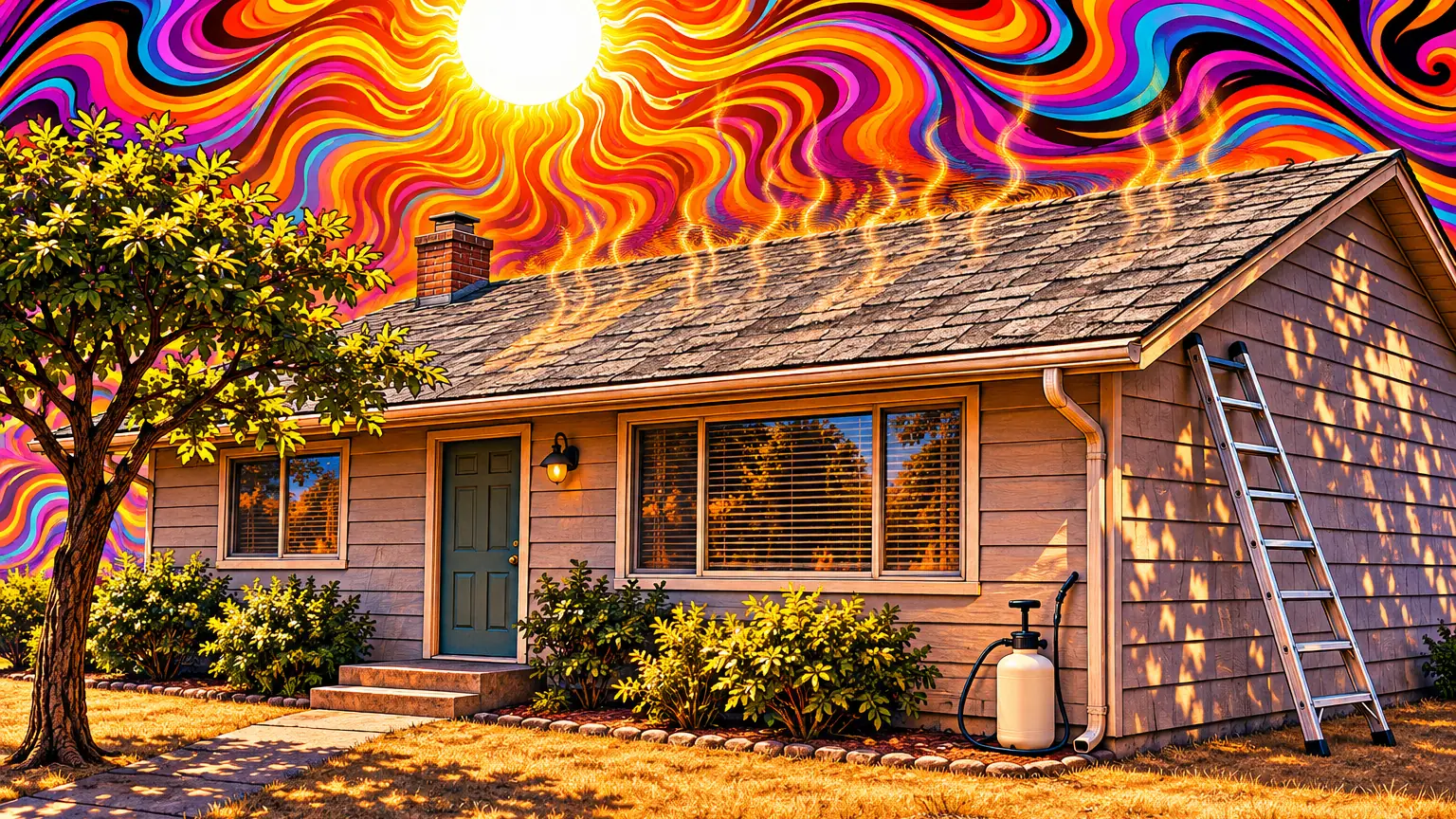
Yes, on the right roof. Heat isn't a reason rejuvenation stops working. It's the reason roofs need it in the first place. Sun and heat are what pull the oil out of asphalt shingles. A hot climate is where that drying happens fastest, so it's where the question of putting oil back comes up first.
What a hot climate changes is the timing, the attic, and the questions you should ask before anyone sprays. It doesn't change the basic rule: the roof has to be sound. A roof the sun has already curled and cracked needs a roofer, not a treatment.
Why heat is what ages a shingle roof
An asphalt shingle is oil and stone. The asphalt holds it together and keeps it flexible, and the granules on top are its sunscreen. From the day the roof goes on, sun and heat start pulling oil out of the asphalt. The shingle stiffens, the granules lose their grip, and grit starts showing up in the gutters.
A dark roof takes a lot of sun. Lawrence Berkeley National Laboratory's Heat Island Group says traditional dark roofs "strongly absorb" ultraviolet, visible and near-infrared light. It also says "On a typical summer afternoon, a clean white roof that reflects 80% of sunlight will stay about 31°C (55°F) cooler than a gray roof that reflects only 20% of sunlight." Your shingle roof is the gray roof in that sentence. It sits up there all afternoon and soaks it up.
The people who inspect roofs for a living agree on what that does. InterNACHI, the home inspectors' association, says in its life expectancy chart that "The life of a roof depends on local weather conditions, building and design, material quality, and adequate maintenance." Then, flatly: "Hot climates drastically reduce asphalt shingle life." Roof Maxx says much the same in its own FAQ, checked November 2026: how fast shingles dry out "depends on factors such as regional climate and the intensity of UV ray exposure."
None of that means a roof in a hot place is doomed. The Asphalt Roofing Manufacturers Association says in its FAQ that "Asphalt shingles perform well in extreme temperatures". Shingles are made to take heat. Heat just runs the aging clock faster.
Dry heat and humid heat wear a roof differently
Not every hot place is hot the same way, and your roof can tell the difference.
In a hot, dry climate the story is mostly sun. Long, clear days do the oil-loss work at full speed, so the usual signs arrive early: a dull surface, edges starting to stiffen, grit in the downspouts. The slope that takes the most sun usually looks years older than the one that doesn't, even though they went on the same day.
In a hot, humid climate you get the same sun plus moisture, and that brings a second problem people often mistake for aging: black streaks. ARMA's bulletin on algae says "Algae growth occurs to varying degrees in all regions of the U.S. and southern regions of Canada, especially those subjected to warm, humid conditions." Streaks are a cleaning question, not a rejuvenation question, and House Dressing makes no algae claim. What the streaks are and how they get cleaned safely is in our post on black streaks and roof rejuvenation.
Humidity also matters on the day of the job. Our technical data sheet says "Cure times lengthen in cooler temperatures and higher humidity." More on that below.
What rejuvenation can do on a hot-climate roof, and what it can't
What it does is the same everywhere. A rejuvenator puts oil back into asphalt the sun has dried out. On a sound roof, that helps the shingles stay flexible and hold on to the granules they still have. House Dressing doesn't sit on top like paint. Our data sheet says "It is not a surface coating." It soaks into the shingle and works on the asphalt. The lab numbers behind that are on the science page, and they are bench results on samples, not a forecast for your roof.
What it can't do is the same everywhere too. It doesn't fix leaks. It doesn't flatten shingles the sun has already curled or mend the ones that have cracked. It doesn't reset the age of the roof. Our data sheet says it "does not restore shingles that are already missing, broken or significantly deteriorated." It also carries a line every homeowner in a hot place should read twice: "Field results vary with shingle type, age, condition, pitch, exposure and climate."
That last word matters here. The same sun that dried your shingles keeps working on the treatment, which is why brands plan on repeat treatments. How long one lasts in a hot climate is the question everyone wants answered, and nobody we know of has published figures by climate. No field study has established how many years of service life the treatment adds to any individual roof, and no such claim is made here. Our post on how long roof rejuvenation lasts covers what shortens a treatment and when a second one makes sense.
Timing is where heat really changes things. Roof Maxx's FAQ says many roofs are ready for a treatment somewhere between 5 and 25 years old. That's a wide range, and by Roof Maxx's own account climate is part of the reason. If the sun ages roofs faster where you live, the right window can open sooner than the calendar suggests. Our roof rejuvenation page is blunt about what decides it: "Age matters less than condition." So have a sound roof looked at while it's still sound, rather than waiting for it to hit some birthday.
The heat under your roof: attic ventilation
A shingle in a hot climate can cook from both sides. The sun hits it from above, and a poorly vented attic holds heat against the deck underneath. ARMA's FAQ says "Ventilation moves heat out of the attic space. This helps prolong the service life of the roof."
Rejuvenation does nothing for an attic that can't breathe. If the hot air has no way out, the shingles keep baking from below whether they've been treated or not. ARMA describes ventilation as air coming in low, at the soffit or the bottom edge of the roof, and leaving high, usually at the ridge. A good applicator will check both and tell you if ventilation is the bigger problem. If that means calling a roofer before you spend money on a treatment, that's the right call, and the honest applicator is the one who makes it.
You don't need to climb up there to check any of this yourself. Ask the person you're paying to inspect.
Heat on the day of the job
Hot weather isn't a reason to skip the work, but it is a reason to ask how the work gets done. Roof Maxx says its product takes 30 minutes to an hour to soak in, "Depending on the climate." Our sheet measures cure times at 70 to 80°F and 50 percent humidity, and they run longer when it's cooler or more humid. Treated shingles are slippery until they cure, one more reason this is not a weekend project.
Two things on our sheet are worth knowing where summers are hot. It sets a storage range for the product of 60 to 110°F. And it publishes no maximum temperature for spraying and no rule for a roof that has been in the sun all day. We're not going to invent one for this post. Ask your applicator where the product sits before it reaches your roof, and how the crew plans around the hottest part of the day. For rain, frost and cure times, see the best time of year for roof rejuvenation.
Five questions to ask an applicator where summers are hot
- Is my roof still a candidate, slope by slope? Ask about the side that takes the most sun in particular. It's usually the oldest-looking face of the house.
- Did you check the attic ventilation, and is it part of the problem? If the answer is a shrug, keep asking.
- Where is the product stored before it gets here? The data sheet gives a range. A good answer sounds like someone who has read it.
- When in the day will you spray, and what happens if the roof is too hot or the air too humid? You want a plan, not "we'll see."
- When should we look at the roof again, and what will you check? That's a better promise than a number of years.
And one for newer roofs: if the shingles are still under the manufacturer's warranty, read it before anyone sprays anything.
The bottom line
A hot climate is where roof rejuvenation matters most, not where it stops applying. Heat is what dries shingles out, so the sun-baked roof is the one asking for oil back first. The rules don't bend for the weather, though. You still need a sound roof, an honest inspection, an attic that breathes, and nobody promising you years.
If your roof has started shedding grit and looking tired on the sunny side, take the three-question fit check on our roof rejuvenation page. Then find an applicator who will walk the roof before quoting it. And if your shingles are already curled, cracked or missing, our guide to whether your roof is too far gone will save you a sales call.
Common questions
Will roof rejuvenation make my roof hotter?
The treatment can darken the shingles for a while. Our data sheet says the darkening diminishes with weathering, and Roof Maxx says its darker shade "typically fades gradually over months." We have not seen a published test of what any rejuvenation treatment does to a roof's reflectance or surface temperature, ours included, so we make no claim either way. If your roof was sold as a cool roof product, ask the shingle maker before anyone treats it.
Does roof rejuvenation wear off faster in a hot climate?
Nobody we know of has published figures for how long a treatment lasts by climate, so be careful with any number you are quoted. The sun and heat that dried your shingles in the first place keep working on the treatment too, which is why brands plan on repeat treatments. Ask your applicator for a re-inspection plan, not a promise of years.
Can rejuvenation fix shingles the sun has already curled or cracked?
No. Rejuvenation is maintenance for a sound roof. Our data sheet says it does not restore shingles that are already missing, broken or significantly deteriorated, and cracked, curling or missing shingles across large areas mean repair or replacement first. A good applicator will tell you that on the roof, not from the driveway.
Want the numbers for your roof or your market?
Drop your email and we send pricing, the dealer model, and the test data.
Get the pack →