
White label roof rejuvenation vs spraying it yourself: which one pays a roofer
September 22, 2026 · House Dressing
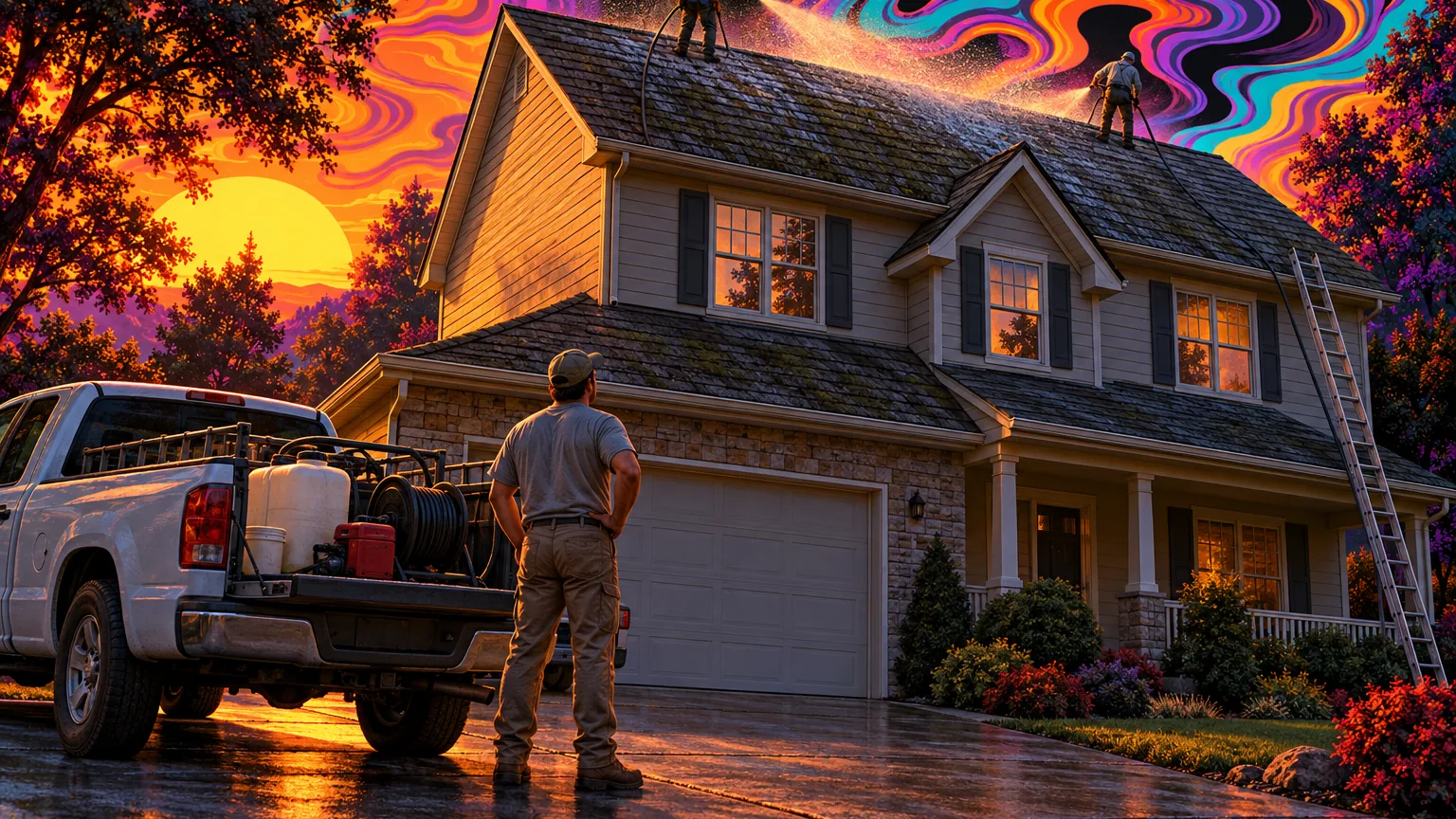
Short answer: white label roof rejuvenation pays you less per roof and asks almost nothing of you. Spraying it yourself pays you more per roof and asks for a crew, some gear and your reputation on every job. Neither one is a scam and neither one is free money. Which one pays better depends on one question most contractors skip: do you have crew hours sitting idle, or do you not?
This post walks through both with real numbers, including a competitor's, because you are going to find their page anyway.
Three ways a roofer can add rejuvenation right now
A year ago the choice was basically franchise or figure it out yourself. There are now three organised roads, and they are genuinely different businesses.
The franchise or licensed dealership. You pay a buy-in, you usually pay ongoing fees, you work an assigned territory and you sell under the franchise brand. Roof Maxx is the big one. We went through what that costs, and what you can and cannot find out before you sign, in how much a Roof Maxx dealership costs.
White label. You sell the job under your own company name, then hand it to a fulfilment network whose crew does the spraying. You pay them a flat rate per square and keep whatever you charged above it. No equipment, no product on your shelf, no ladder time.
Dealer-direct. You buy the product, your crew applies it, you set the price and you keep the spread. That is how House Dressing works: no franchise fee, no royalty, no monthly minimums, no territory tax.
The franchise road is covered to death elsewhere, including on our own Roof Maxx alternative page. The one worth a closer look is white label, because it is being marketed hard to roofers, state by state, and the pitch is good.
How white label roof rejuvenation works, with the published math
The best documented example we could find is a regional program in Arizona. To its credit, it publishes its numbers right on the page, which is more than most of this industry does. The model is "You Sell. We Fulfill." Here is what its site lays out for a standard roof:
- Your cost: $85 per square, paid to the program.
- Average sell price: $125 per square, with a stated range of $120 to $130.
- Average roof: 25 squares.
- So you charge the homeowner $3,125, pay the program $2,125, and keep $1,000 gross. That is a $40 per square spread.
- They project 4 to 8 jobs a month for an active partner.
The application is handled by their authorized territory operator using their own chemistry. You close the sale, submit the job, and it gets done under your name. No sprayer, no inventory, nothing to learn about cure times.
That is a real offer and for some contractors it is the right one. A thousand dollars for a sale you made from your own customer list, with zero field labour, is not nothing. If you are a sales-heavy shop with every crew booked through the season, it is close to found money.
The same roof, sprayed by your own crew
Now run that same 25 square, $3,125 roof through a dealer-direct model.
The figures we publish on our dealer program page put dealer cost, oil plus crew, at about 40 percent of the ticket and dealer margin at about 60 percent, with a treatment typically landing between $3k and $6k. On a $3,125 job, 60 percent is roughly $1,875. Treat that as an illustration, not a promise, because the real split moves with your market, the roof size and how you pay your crew.
So on paper, doing it yourself keeps about $875 more on that roof than the white label spread. Before you get excited, here is what that $875 is actually paying for:
- Gear. A commercial sprayer, hose and safety kit. We tell start-up owners to budget $1k to $3k for this, and an existing roofer may already own most of it.
- Crew time. A typical residential application is 2 to 4 hours, one crew, one visit. That crew cost is already inside the 40 percent, but those hours have to come from somewhere.
- Product on hand. One pail treats one average roof, and a first order ships in 7 to 14 days. You reorder as you book, but you are holding stock.
- The risk. If the job goes wrong, it is your crew, your ladder and your fix.
The honest way to read the gap: white label pays you for selling. Dealer-direct pays you for selling and for doing the work. If you would be paying a crew to stand around on a slow Tuesday anyway, that extra margin is almost pure upside. If you would have to pull a crew off a $25k replacement to do it, it is not.
The part the spreadsheet misses: your name on someone else's work
Here is the thing the per square math does not show. Under white label, the homeowner hired you. Your logo is on the estimate. Your name is on the review they leave. But somebody else's crew is on the roof.
That raises four questions you should get answered in writing before you sign anything:
- Who qualifies the roof? This is the single biggest risk in rejuvenation. A treatment on a sound, aging roof is good maintenance. A treatment on a roof that needed replacing is a complaint waiting for the first leak. If you sell the job and someone else decides whether the roof is a fit, find out who, and what they walk away from. We wrote a whole checklist for spotting a roof that is too far gone, and whoever sprays should be using something like it.
- Who does the prep? Debris, moss, gutters and anything that needs repair before treatment. If prep is out of scope, you will be the one explaining the result.
- Who answers the phone after? When the homeowner calls in a month with a question, they call you. Know what the fulfilment side will actually do and how fast.
- Whose workmanship terms apply? You are the contractor of record in the homeowner's eyes. Make sure whatever you promise them is something the crew doing the work also stands behind.
None of that is a reason to rule white label out. It is a reason to treat it like hiring a subcontractor, because that is what it is, with your reputation as the deposit.
Dealer-direct flips it. More work, but every step is yours: your crew walks the roof, your crew says no when the answer is no, and you know exactly what went on it. For a contractor who has spent fifteen years building a name in one town, that control is often worth more than the margin.
Which model fits which contractor
A rough guide, from the shape of each deal rather than anything cleverer:
White label tends to fit if:
- Your crews are fully booked on higher value work through the season.
- You are mostly a sales or estimating shop and subcontract field work already.
- You want to test whether your customers will buy rejuvenation at all before you spend anything.
- You sell a handful of these a month, not a steady stream.
Dealer-direct tends to fit if:
- You have crew hours that go unbilled: rain days, half days, the gap between replacements.
- You run soft-wash, gutter or exterior crews who are already on ladders and on roofs.
- You want to own the qualifying call, because your name is the product in your town.
- You expect enough volume that the bigger per job margin adds up.
Some contractors will reasonably start on one and move to the other. If white label proves your customers want it and your volume climbs, the margin you are leaving on the table grows with every job, and at some point bringing it in house is just arithmetic.
What we would not do is choose on the headline number alone. The $1,000 is real and the $1,875 is illustrative, and the difference between them is mostly your crew, your time and your risk. Price those three honestly for your own shop and the answer usually picks itself.
The bottom line
White label roof rejuvenation is a clean way to sell the service without touching a sprayer, and it pays accordingly. Spraying it yourself is more work and more margin, with total control over which roofs get treated. The better model is the one that matches the crew hours you actually have.
If you have the crew and want the spread, that is exactly who House Dressing is built for. No franchise fee, no royalty, co-branded marketing with your logo on it, and the oil at dealer pricing. Start with the dealer program and we will walk through the numbers for your market on the call. And if after that call white label is the better fit for you, we will tell you that too.
Common questions
Can I sell roof rejuvenation under my own company name?
Yes, two ways. A white label program puts your brand on a job that somebody else's crew sprays. Dealer-direct means your own crew sprays it, and with House Dressing you get co-branded estimate templates, ad creative, yard signs and a homeowner explainer you drop your logo into. Either way the homeowner deals with your company.
Is white label roof rejuvenation more profitable than doing it yourself?
Per job, no. One published white label program shows about $1,000 of gross profit on a 25 square roof, and spraying that same roof with your own crew keeps a bigger share of the ticket. But the self-perform number has to carry your crew, your gear and your risk. If your crews are booked solid and you only want to sell, white label can win per hour of your own time.
Do I need a franchise to add roof rejuvenation to my roofing company?
No. A franchise is one route, white label is another, and buying the product direct is a third. House Dressing is dealer-direct, with no franchise fee, no royalty and no monthly minimums. You buy oil at dealer pricing and charge what your market will pay.
Want the numbers for your roof or your market?
Drop your email and we send pricing, the dealer model, and the test data.
Get the pack →